

 Information
Notifications
Tutorials
188. Layer Window Details
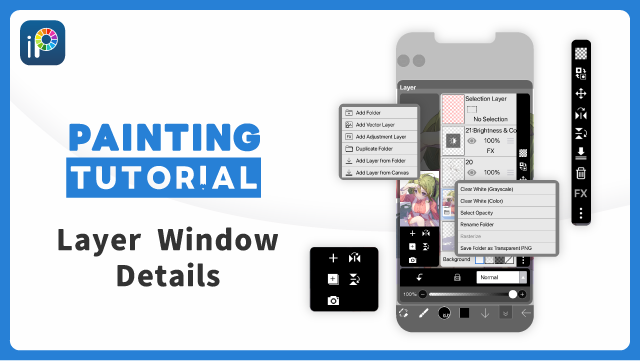
"Layer window" have a variety of features that can be applied to layers. As there are many features, there is a lot to remember, and it may take some time to learn how to use them all correctly. However, if you learn how to use these correctly, your efficiency will increase, and the quality of your illustrations and manga will also improve significantly.
Please refer to "About Layers" for more on layers.
Layer Window
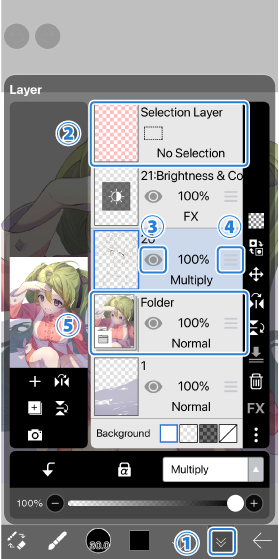
①[ Layer Window ]: Open the Layer window.
②[ Selection Layer ]: This is the layer used when creating the selected range.
③[ Layer Display/Hide ]: Switches between display/hiding the folder or layer.
④[ Reorder Handle ]: By dragging the handle up or down, you can sort the display order of the folder or layer.
⑤[ Layer Folder ]: This enables you to collect multiple layers together into a folder.
See "Layer: Selection Layer" for details on the Selection Layer.
See "Layer: Layer Folders" for details on the Layer Folder.
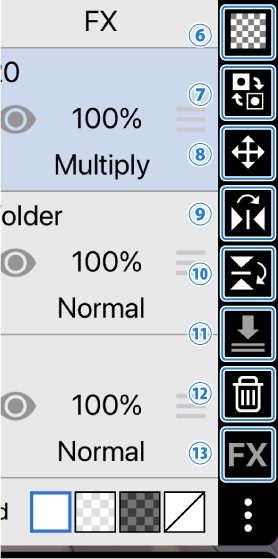
⑥[ Clear Layer ]: Deletes the content drawn on to the layer. If the "Selected layer" is selected, the selected range is cleared.
⑦[ Invert Layer Color ]: This inverts the color and brightness of the layer. The color will complement the original color, and the light areas shall become dark. If the "Selected layer" is selected, this inverts the selected range.
⑧[ Move Layer ]: This can be used for moving, enlarging/shrinking, rotating, and changing the form of the layer.
⑨[ Invert Layer Horizontally ]: Rotates the layer left and right.
⑩[ Invert Layer Vertically ]: Rotates the layer up and down.
⑪[ Merge Layer Down ]: Merges the layer with the layer below it.
⑫[ Delete Layer ]: Deletes the layer.
⑬[ Edit Adjustment Layer ]: You can re-adjust the parameters of the adjustment layer.
See "Transform tool details" for details on the Move Layer.
See "Check by Reflecting Horizontally" for details on the Invert Layer Horizontally.
See "Let's Merge Layers" for details on the Merge Layer Down.
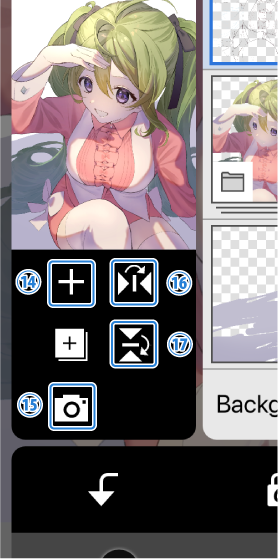
⑭[ Add Layer ]: Adds a blank layer.
⑮[ Import from Photo Library ]: Read image from photo library.
⑯[ Invert Canvas Horizontally ]: Rotates the canvas left or right. All layers are inverted left or right.
⑰[ Invert Canvas Vertically ]: Rotates the canvas up or down. All layers are inverted up or down.

⑱[ Clipping ]: Performs clipping on the layer below the selected layer.
⑲[ Alpha Lock ]: Enables you to edit only the opaque area of the layer. The opacity level of each of the pixels is maintained.
Alpha lock is not available for layer folders or vector layers.
⑳[ Opacity ]: Sets the opacity level of layer or folder.
Command Menu
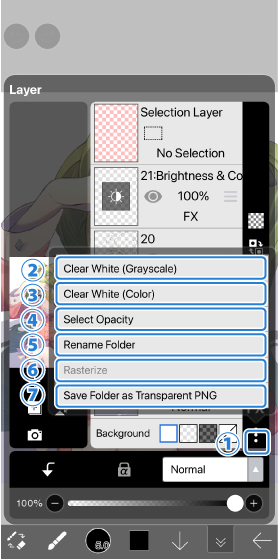
①[ Menu ]: Opens the menu.
②[ White to Transparent (Grayscale) ]: Converts the layer to grayscale and makes the white areas transparent. Colors with white components have a lower level of opacity.
③[ White to Transparent (Color) ]: Makes the white areas transparent. Colors that include white elements have a lower level of opacity.
④[ Select Opacity ]: Creates a selection range for the opaque areas of the layer.
⑤[ Rename Layer ]: Changes the name of the layer or folder.
⑥[ Lock Layer ]: Locks the layer so that it cannot be edited.
⑦[ Start Solo Mode ]: Displays only the selected layer.
⑧[ Rasterize ]: Convert the vector layer to a regular layer. Rasterizing allows you to draw with a brush or erase with an eraser.
⑨[ Save Layer as Transparent PNG ]: Export and save the selected layer or folder as a transparent PNG image in your photo library.
See "Layer: Naming your layers to manage them" for details on the Rename Layer (Folder).
See "Layer: Rasterize" for details on the Rasterize.
See "Layer: Save Layer as Transparent PNG command" for details on the Save Layer as Transparent PNG (Layer or Folder).
Add Special Layer Menu
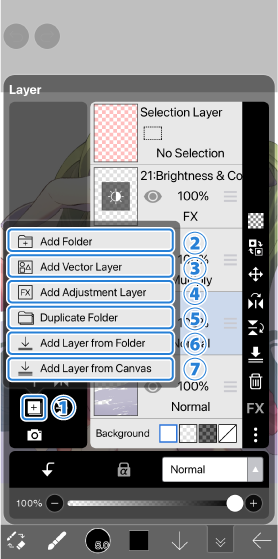
①[ Add Special Layer ]: Opens the menu.
②[ Add Folder ]: Adds a blank layer folder.
③[ Add Vector Layer ]: Adds a vector layer.
④[ Add 3D Layer ]: Adds a 3D layer.
⑤[ Add Adjustment Layer ]: Adds an adjustment layer.
⑥[ Duplicate Layer ]: Duplicates the selected layer. It will be displayed as "Duplicate Folder" when a folder is selected.
⑦[ Add Layer from Folder ]: Merges and adds layers within the selected folder. This item is only displayed when the layer folder is selected.
⑧[ Add Layer from Canvas ]: Merges and adds all layers.
See "Layer: Layer Folders" for details on the Add Folder.
See "Adjustment Layer" for details on the Add Adjustment Layer.
See "Layer: Add Layer from Canvas" for details on the Add Layer from Canvas.
Background Row
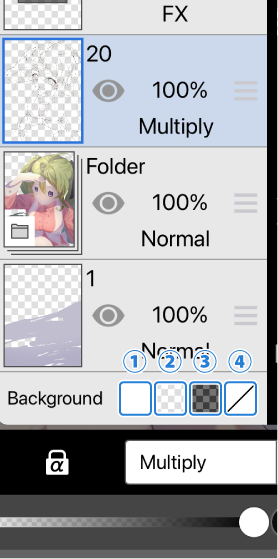
①[ Background Color ]: Sets the background color of the canvas.
②[ Transparent Background (Light) ]: Sets the canvas background to transparent (light).
③[ Transparent Background (Dark) ]: Sets the canvas background to transparent (dark).
④[ Paper Canvas ]: Sets the paper texture of the canvas background.
See "Apply Canvas Papers to your canvas" for details on the Paper Canvas.
Blending Mode List
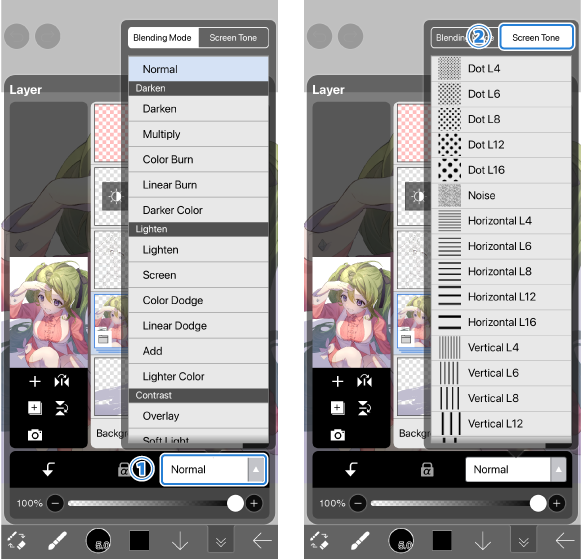
①[ Blending Mode ]: Sets the blend mode of the layer.
②[ Screentone ]: Applies the screen tone to the layer.
See "Blend mode details" for details on the blend mode.
See "Layers: Screentone" for details on the Screentone.
Floating Layer Window
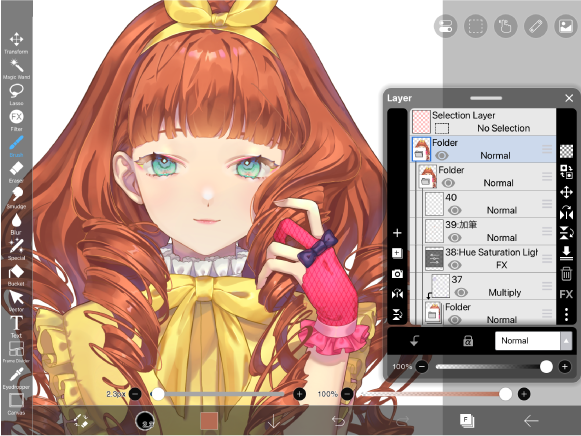
The Floating Layer window is a feature that allows you to always keep the Layer window displayed on the canvas screen as you do your drawing.
This feature is only available on tablet devices and PCs.
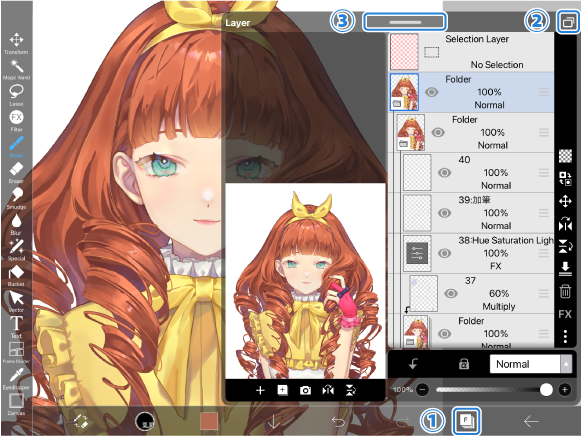
Open the ①[ Layer Window ]. Tap the ②[ Floating Window button ] or drag the ③[ Move Bar ] to display the Floating Layer window.
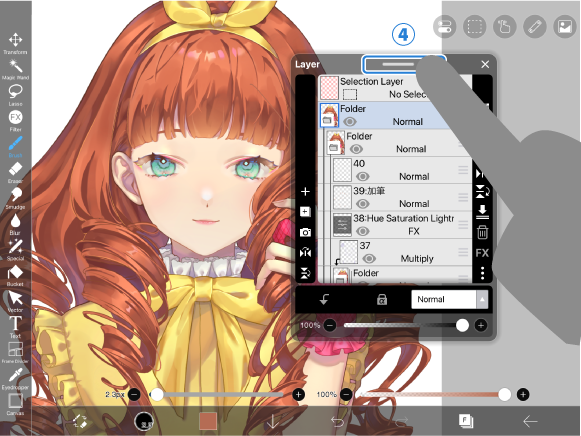
You can adjust its position by dragging the ④[ Move Bar ].
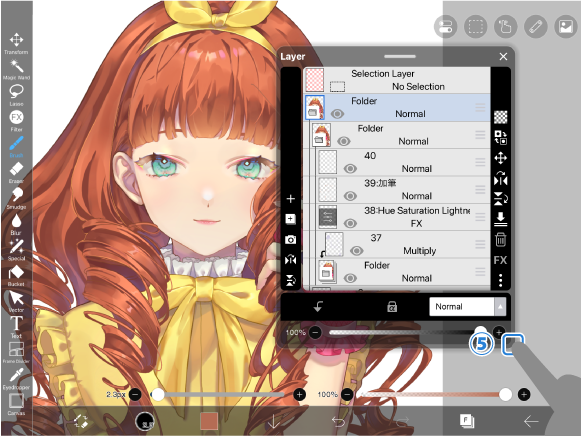
You can adjust the size by dragging the ⑤[ bottom right corner ] of the Floating Layer window.
You can also resize it by dragging the bottom left corner, left, bottom and right edges of the window.
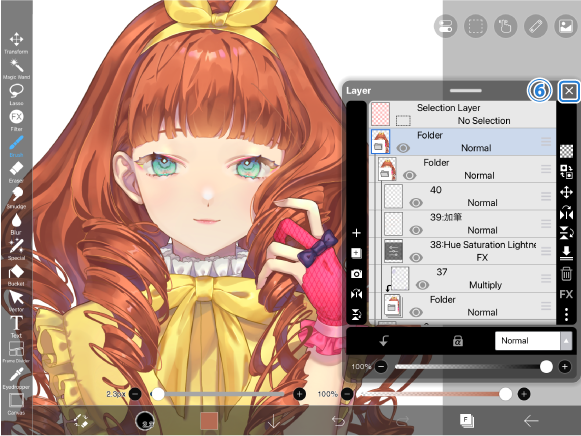
You can hide it by tapping the ⑥[ Close button ].
 Layer Window Details
Chapter
-
 01.Introduction
-
 02.Start Creating an Artwork
-
 03.Toolbar and Tool Selection
-
 04.Do Your Draft Sketch by Hand
-
 05.About Layers
-
 06.Let's Trace
-
 07.Undo and Eraser
-
 08.Fine Tuning Using the Lasso tool
-
 09.Check by Reflecting Horizontally
-
 10.Select Colors in the Color window
-
 11.Use Color Fill for the Undercoat
-
 12.Turn Clipping On
-
 13.Making a Gradation (Shading)
-
 14.Select a color from the canvas or layer
-
 15.Set the Time before Quick Eyedropper Starts
-
 16.Create Highlights and Shadows
-
 17.Paste a Texture
-
 18.Let's Merge Layers
-
 19.Sign Your Artwork
-
 20.View Your Artwork
-
 21.Post Your Artwork
-
 22.Share Your Artwork
-
 23.Open your ibisPaint data in Clip Studio Paint
-
 24.Premium Membership / Ad Removal Upgrade (for iPhone/iPad, Android)
-
 25.Premium Membership / Pro Upgrade (for Windows, Mac)
-
 26.Smart Features and Smart Credits
-
 27.Synchronizing the artworks on your device with Cloud Storage
-
 28.Save the past state of an Artwork as an IPV file
-
 29.Rearrange artworks
-
 30.Artworks Folder Feature
-
 31.Make custom brush
-
 32.Create Original Brush Patterns
-
 33.Installing and Exporting the Custom Brush
-
 34.Release a Custom Brush to the Online Gallery
-
 35.Brush Export and Import
-
 36.Search For Brushes
-
 37.Display images to use as reference
-
 38.Add Color to the Analog Image using Multiply
-
 39.Stabilizer
-
 40.Layer: Clipping is convenient
-
 41.Layer: Changing the color with Alpha Lock
-
 42.Layer: Let's try using Screen Tone
-
 43.Layer: Selection Layer
-
 44.Layer: Save Layer as Transparent PNG command
-
 45.Layer: Naming your layers to manage them
-
 46.Layer: Rasterize
-
 47.Layer: Layer Folders
-
 48.Layer: Move/Transform Layer Folder
-
 49.Layer: Add Layer from Canvas
-
 50.Vector Layer
-
 51.How to edit a brush shape
-
 52.Contents Layer Selection
-
 53.Apply Canvas Papers to your canvas
-
 54.Display Grid on the Canvas
-
 55.Export an Artwork (Save)
-
 56.Export in CMYK (Save)
-
 57.Save canvas as Transparent PNG
-
 58.Make the background transparent with Eraser Bucket
-
 59.Bucket Tool: Surrounding Fill / Surrounding Eraser
-
 60.Putting texture to the floor with Perspective Form
-
 61.Skirt with Mesh Form
-
 62.Entering text with Text tool
-
 63.Creating manga with Frame Divider tool
-
 64.Enlarging the canvas with Canvas Size
-
 65.Cutting off the canvas with Trim
-
 66.Create a Manga Manuscript for Printing
-
 67.Canvas creation with resolution (dpi) specification
-
 68.Changing image resolution with Resize
-
 69.Change canvas Color Mode
-
 70.Output High-Resolution Images with AI (Artificial Intelligence)
-
 71.AI Disturbance
-
 72.Texture with Material tool
-
 73.Cut, Copy, Paste
-
 74.Ruler: Straight Ruler
-
 75.Ruler: Circular Ruler
-
 76.Ruler: Elliptical Ruler
-
 77.Ruler: Radial Ruler
-
 78.Ruler: Mirror Ruler
-
 79.Ruler: Kaleidoscope Ruler
-
 80.Ruler: Array Ruler
-
 81.Ruler: Perspective Array Ruler
-
 82.Shape Tool
-
 83.Drawing Tool: Straight Line
-
 84.Drawing Tool: Rectangle
-
 85.Drawing Tool:Circle
-
 86.Drawing Tool:Ellipse
-
 87.Drawing Tool:Regular Polygon
-
 88.Drawing Tool:Bezier Curve
-
 89.Drawing Tool:Polyline
-
 90.Shape Tool: Rounded Rectangle
-
 91.Shape Tool: Thin Arrow
-
 92.Shape Tool: Speech Bubble
-
 93.Selection Area tool: Color Range
-
 94.Selection Area tool: Expand/Contract Selection Area
-
 95.Special: Liquify Pen
-
 96.Special: Lasso Fill
-
 97.Special: Lasso Eraser
-
 98.Special: Copy Pen
-
 99.Filter (Adjust Color): Brightness & Contrast
-
 100.Filter (Adjust Color): Tone Curve
-
 101.Filter (Adjust Color): Hue Saturation Lightness
-
 102.Filter (Adjust Color): Color Balance
-
 103.Filter (Adjust Color): Extract Line Drawing
-
 104.Filter (Adjust Color): Find Edges (Handwriting)
-
 105.Filter (Adjust Color): Find Edges
-
 106.Filter (Adjust Color): Change Drawing Color
-
 107.Filter (Adjust Color): Mono Color
-
 108.Filter (Adjust Color): Grayscale
-
 109.Filter (Adjust Color): Black & White
-
 110.Filter (Adjust Color): Posterize
-
 111.Filter (Adjust Color): Invert Color
-
 112.Filter (Adjust Color): Gradation Map
-
 113.Filter (Adjust Color): Levels Adjustment
-
 114.Filter (Adjust Color): Replace Color
-
 115.Filter (Blur): Gaussian Blur
-
 116.Filter (Blur): Zooming Blur
-
 117.Filter (Blur): Moving Blur
-
 118.Filter (Blur):Spin Blur
-
 119.Filter (Blur): Lens Blur
-
 120.Filter (Blur): Mosaic
-
 121.Filter (Blur): Unsharp Mask
-
 122.Filter (Blur): Frosted Glass
-
 123.Filter (Style): Stroke (Both)
-
 124.Filter (Style): Stained Glass
-
 125.Filter (Style): Wet Edge
-
 126.Filter (Style): Glow (Inner)
-
 127.Filter (Style): Bevel (Inner)
-
 128.Filter (Style): Bevel (Outer)
-
 129.Filter (Style): Emboss
-
 130.Filter (Style): Relief
-
 131.Filter (Style): Relief HQ
-
 132.Filter (Style): Waterdrop (Rounded)
-
 133.Filter (Style): Stroke (Outer)
-
 134.Filter (Style): Glow (Outer)
-
 135.Filter (Style): Satin
-
 136.Filter (Style): Drop Shadow
-
 137.Filter (Style): Extrude
-
 138.Filter (Style): God Rays
-
 139.Filter (Draw): Parallel Gradation
-
 140.Filter (Draw): Concentric Gradation
-
 141.Filter (Draw): Radial Line Gradation
-
 142.Filter (Draw): Radial Line
-
 143.Filter (Draw): Speed Line
-
 144.Filter (Draw): Clouds
-
 145.Filter (Draw): QR Code
-
 146.Filter (Smart): Watercolor Filter
-
 147.Filter (Smart): Background Removal
-
 148.Filter (Artistic): Anime Background
-
 149.Filter (Artistic): Manga Background
-
 150.Filter (Artistic): Chromatic Aberration (Color Shift, RGB Shift)
-
 151.Filter (Artistic): Glitch
-
 152.Filter (Artistic): Noise
-
 153.Filter (Artistic): Retro Game
-
 154.Filter (Artistic): Chrome
-
 155.Filter (Artistic): Bloom
-
 156.Filter (Artistic): Cross Filter
-
 157.Filter (Artistic): Sheer
-
 158.Filter (Pixelate): Pixelate Crystalize
-
 159.Filter (Pixelate): Hexagonal Pixelate
-
 160.Filter (Pixelate): Square Pixelate
-
 161.Filter (Pixelate): Triangular Pixelate
-
 162.Filter (Pixelate): Pointillize
-
 163.Filter (Pixelate): Dots (Hexagonal)
-
 164.Filter (Pixelate): Dots (Square)
-
 165.Filter (Transform): Expansion
-
 166.Filter (Transform): Fisheye Lens
-
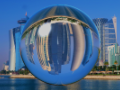 167.Filter (Transform): Sphere Lens
-
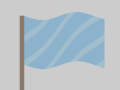 168.Filter (Transform): Wave
-
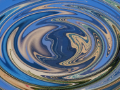 169.Filter (Transform): Ripple
-
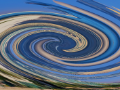 170.Filter (Transform): Twirl
-
 171.Filter (Transform): Polar Coordinates
-
 172.Filter (Frame): Table
-
 173.Filter (Frame): Blur Frame
-
 174.Filter (Movie): Rain
-
 175.Adjustment Layer
-
 176.Create an animation
-
 177.Animation Feature: Video Mode
-
 178.Animation Feature: Audio Tracks in Video Mode
-
 179.Manga Function: Let's create a manga manuscript
-
 180.Manga Function: Master the Manga creation tools
-
 181.Manga Function: Make Use of Materials
-
 182.Manga Function: Publishing and Printing your Manga
-
 183.Changing Devices & File Transfers
-
 184.Settings window details
-
 185.Change the Background Color of the Canvas
-
 186.Details of Brush Parameters
-
 187.Bucket tool details
-
 188.Layer Window Details
-
 189.Transform tool details
-
 190.Blend mode details
-
 191.View Menu details
-
 192.How to upload transparent PNG onto X
-
 193.Importing and exporting Photoshop files (PSD)
-
 194.Posting Multiple Pages of Comic to the Online Gallery
-
 195.Gestures, Keyboard shortcuts (iOS,iPadOS,Android versions)
-
 196.Gestures, Keyboard shortcuts (Windows Version)
-
 197.Display a Crosshair Symbol When Hovering the Stylus Pen
-
 198.Set Up Palm Rejection
-
 199.Use a Promo Code
-
 200.About ibisAccount: Creating an Account
-
 201.About ibisAccount: Log In
-
 202.About ibisAccount: Delete Your Account
- Artwork Rankings

- Artist Rankings
- Official accounts


